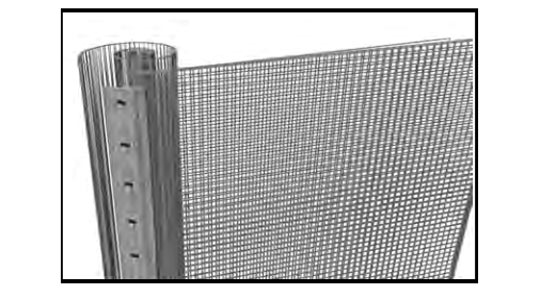
WINDBREAK NETS

It's well known that frequent and intense winds can cause significant damage to crops or greenhouses. Therefore, windbreaks are essential, especially in particularly windy areas.
Benefits of windbreak nets:

  • Mitigation of the mechanical effects of wind.
  • Reduction of evaporation and transpiration of water from the soil.
  • Reduction of frost and frost caused by cold air inflows and consequent savings in greenhouse heating.
  • Retention of fumes, harmful fumes, salt and sand carried by the winds.

The optimal windbreak net is a 50% net. This type of net can protect a distance of up to 8-10 times its height without creating turbulence or vortices (e.g., a 2-meter high net would protect 16 meters). If the nets are also required to eliminate salt or other dust, denser nets such as 60 or 70% are needed.
Using nets that are too dense (e.g., 90%) is not recommended because they can create vortices upwind or downwind that can cause greater damage than the original wind would have caused.

NET 50%
art. O50 HDPE UV stabilized 0.28
Uses: windbreak, medium shading
50% wind reduction up to 8 times the barrier height (e.g. 2m high barrier, protection 8×2m = 16m)
Colours (Shading): black (50%) – green (38%) – white (15%)
Heights: 1 – 1.5 – 2 – 2.5 – 3 – 4 – 5 – 6
m Lengths: 100-200 m or on request

NET 70%
art. O70 HDPE UV stabilized 0.28
Uses: windbreak, anti-drift treatments, dense shading
Wind protection (-50%): up to 5 times the barrier height
Colors (Shading): black (70%) – green (59%)
Visual screening effect: medium
Heights: 1 – 1.5 – 2 – 2.5 -3 – 4 – 5 – 6
m Lengths: 100-200 m or on request

windbreak nets

NET 60%
art. O60 HDPE UV stabilized 0.28
Uses: windbreak protection from sand and dust, medium shading
Wind protection (-50%): up to 6 times the barrier height
Colours (Shading): black (60%) – green (47%) – white (16%)
Heights: 1 – 1.5 – 2 – 2.5 – 3 – 4 – 5 – 6 m
Lengths: 100-200 m or on request

CREASE
art. CORD
Sewing on the edge of the nets a HDPE polyethylene cord (ø 4 mm) useful for a secure fixing and to significantly extend the resistance and durability of the windbreak nets

Assembly tips and accessories

Arrange a series of iron, concrete, or wooden posts at a distance that must take into account the height of the barrier and the diameter of the posts.

Space between posts diam. 8/10 cm
– Distance for posts 2 to 2.5 metres high: approximately 3 metres
– Distance for posts higher than 3 metres: approximately 2 metres


Fixing the net
Fix the net to the head posts using wooden slats or rubber profiles.


pipes and cables for anti-hail systems

ZINC-ALUMINUM STEEL WIRE
art. FI4
Zinc-aluminium coated steel wire ø 4 mm – for ridge wire
1 Kg = 10 m
Resistance: 980 N./ mm²
Average elongation 4 – 5 %
Packaging: 50 -100 kg

Support cables:
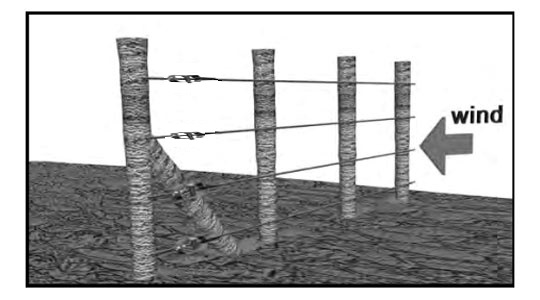
Place the wires or ropes on the side of the posts facing the prevailing wind, at a vertical distance of 40/50 cm. Anchor the end posts with another inclined support.

Attaching the mesh:
Use a pair of ring-type netting pliers to secure the mesh to the cables, spacing the rings approximately 50 cm apart.
This system is quick to install and guarantees excellent, long-lasting hold, even over the years.


STEEL SPIRAL ROPE
art. FU5-19 class AB 1 kg = 8.4 m
Galvanized steel spiral rope with 19 strands – ø 5 mm
Packaging: 50 kg


Fixing cables to wooden poles
GALVANIZED STAPLE 50×40 mm
Art. CAM
U-shaped harpoon staple for fixing ropes and wires to wooden poles
Packaging: 5 kg or on request

NET TYING PLIERS WITH RINGS
item LEG with automatic reloading

item LEG2 with manual reloading Uses: fixing nets to a wire or rope
With automatic reloading
RINGS FOR PLIERS
item LEGAN
Packaging: 1600 pieces

TENSIONER with double ring
art. TEND2
For ropes and cables from ø 4 to 7 mm
FORGED CLAMPS
art. MOR10
For ropes ø 7 to 8 mm
art. MOR6
For ropes ø 4 to 6 mm