
TYPES OF ORCHARD PLANTS
The ever-increasing use of anti-hail nets has led to an evolution in the types of systems, adding new, more practical and functional installation models to the traditional "shed" or "truss" systems, thus reducing construction and management costs. Below is an example of the various types of systems.
CAPANNINA SYSTEMS
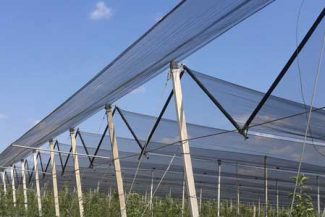


Created over 30 years ago to cover particularly tall trees (4-5 m), it is suitable for orchards with a post-height-to-row spacing ratio of 1 (h/l) or less. To allow for hail to drain away, a slope of 65-70% is required. For proper operation, the netting must be secured at both the ridge wires and the cross wires. The system consists of a load-bearing structure of concrete posts, arranged perpendicular to each other. The structure is completed with wires and ropes arranged to allow for a predetermined netting inclination, while the sheets are joined together with plastic clips to ensure uniform closure.
Net slope: 65-70%
Truss height: 140 – 150 cm
Width of rows: more than 4 metres
Distance between plates: 2 metres
Post caps: self-locking for concrete posts with single bolt for fixing transverse and ridge wires or ropes
Advantages: Good protective effectiveness, hail does not form pockets
Disadvantages: Higher initial cost (higher posts and larger section, double lateral anchors)
SEMI-STOREY SYSTEMS

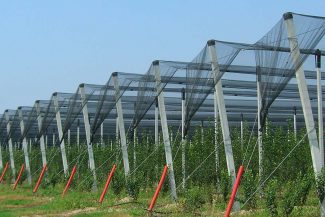

FLAT OR SEMI-FLAT NETTING (unrestricted). This system originated in Austria and is now the most widespread in Italy. Its operating principle is based on the weight of the hailstones lowering the netting at the junction point, thus allowing for partial emptying. As with the shed system, anchoring is provided along the entire perimeter of the orchard. It is not necessary to slope the netting excessively, hence the name "flat" or "semi-flat" systems, although a steeper slope provides better protection. The netting is placed on the ridge wire, without tensioning it, and secured there with netting pins, stitching, or plates. Cross cables are then installed and joined edge to edge with quick-release plates. There are various options for anchoring the netting to the end posts: with a knot ring or with open forks or with a tensioning cable placed at the end posts at variable distances from 1 to 1.5 m.
Net slope: 20-30%
Truss height: 40 cm - 80 cm
Row width: maximum 4 m
Distance between plates: 1.40 - 2 m
Post caps: self-locking for concrete posts with double bolt for fixing transverse and ridge wires or cables, smooth round or cross-shaped for wooden posts.
Advantages: Good production efficiency - Lower initial costs than the shed system.
Disadvantages: Requires a good support structure (perimeter anchors, etc.) - Obstacle to the passage of platforms - Formation of pockets in certain situations.
ELASTIC SYSTEMS


This system originated in France but has also become widespread in Italy, especially in the Northwest. It adapts to most existing systems. Lateral anchors and cross-ropes are not required. It is necessary to provide a net 25-30% wider than the inter-row width. The net is placed against the ridge wire, without tensioning it, and secured with net-holding pins, stitching, or small plates. Small plates are then applied to the edges of the nets and tensioned, connecting them to the ridge wires with elastic cords and pre-assembled hooks. The net thus remains horizontal and does not impede the passage of vehicles. The operating principle is based on the fact that the weight of the hail and the elastic bands lowers the net, thus allowing it to be partially emptied. After various experiences and encountered inconveniences, the elastic system that has prevailed is the one with OVERLAPPED CROSSED NETS, which consists of fixing the elastic cords respectively above and below the net by crossing the edges of the net itself.
Net slope: 0%
Truss height: 0
Row width: no constraints
Advantages: Adaptable to most existing systems – – Thanks to the flexibility of the elastics, the system withstands the action of even violent storms – Does not hinder the passage of vehicles
Disadvantages: Incomplete protection of the lower part of the fruiting wall – High stress on the net due to the formation and persistence of hail pockets – Need to replace the elastics every 5-6 years – Greater shading
MIXED ELASTIC + PLATE IMPLANT


This system requires a double-edged net and uses both elastic and plates, facilitating unloading in the event of heavy hailstorms. However, the cost of accessories is more significant than for other types.
SINGLE-ROW ANTI-COWLING AND ANTI-BEDBUG SYSTEMS


This is a separate cover for each row, used for over 15 years, but recently re-evaluated for its insect, codling moth, and stink bug repellant properties. The net is placed on the ridge wire, reaching 50 cm from the ground, and envelops the row of plants on both sides.
- It adapts to small systems, even if irregular
- Provides total protection against hail
- It prevents the damage caused by the CODLING MOTH (POME FRUIT WORMS) by inhibiting their flight, with the positive consequence of reducing the need for phytosanitary treatments.
- With appropriate measures it is giving encouraging results against the ASIAN STINK BUG.
Disadvantages:
- Some cultivation operations are more difficult.
- Branches can damage the netting when it's windy.
- It is only suitable for medium/small sized plants
- It creates a wind barrier that should not be underestimated when designing and sizing the system.